


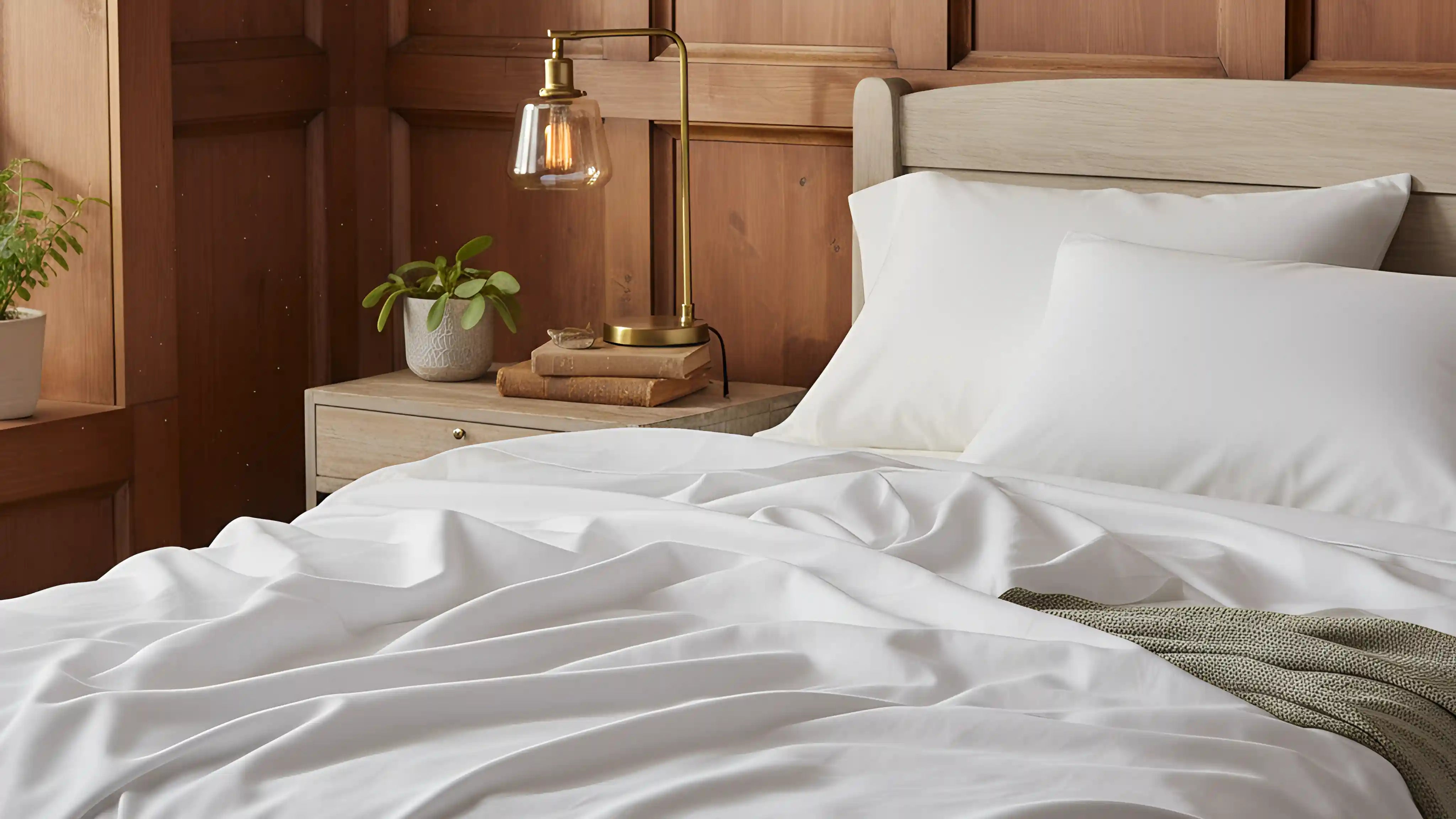
A home editor's investigation into the bamboo bedding phenomenon: what the FTC found when it actually tested ten "bamboo" products, what fifteen sets over three years taught me, and which cooling sheets deliver for hot sleepers.
I used to wake up every morning looking like I'd run a marathon in my sleep. Damp pajamas, tangled hair, sheets kicked to the floor — you know the drill if you're a hot sleeper. So when bamboo bed sheets started popping up everywhere promising "naturally cooling" properties, I was ready to believe anything that might save me from another sweaty night.
That was three years and probably fifteen different sheet sets ago. Today I'm writing this from my bed — yes, I'm that editor who works from bed sometimes — wrapped in what I can confidently say are the best cooling sheets I've ever owned. But getting here involved uncovering some fairly uncomfortable truths about the bamboo bedding industry, including a $5.5 million FTC settlement that changed everything I thought I knew about cooling bed sheets.
Are bamboo sheets actually made of bamboo?
Mostly, no. I discovered this the hard way while researching why my supposedly "naturally antimicrobial" bamboo bedding set kept developing a musty smell after a few weeks.
Major retailers including Walmart and Kohl's paid substantial fines to the Federal Trade Commission for marketing rayon bamboo sheets as pure bamboo. The FTC tested ten popular "bamboo" products and found exactly zero bamboo fibre in any of them. Zero. They were all rayon — a chemically processed material that starts with bamboo plants and ends up as something structurally different.
The part the marketing leaves out: the "natural" properties everyone loves about bamboo do not survive the chemical processing that turns bamboo plants into the silky rayon from bamboo sheets we actually sleep on. No antimicrobial benefit, no UV protection, no naturally cooling property carried over from the plant. Anything a finished sheet does, it does because of fibre structure and weave.
I felt like a fool when I learned this. There I was, spending extra on bamboo luxury bedding thinking I was making an eco-friendly choice, when I was buying rayon with very good marketing.
Which is worth saying plainly, since this article sits on a shop that sells the stuff: we label ours rayon or viscose derived from bamboo, because that is what it is. If a brand will not use that wording, that tells you something.
How I tested fifteen sets
After the bamboo revelation, I decided to test everything myself. Over six months my bedroom became a cooling sheet laboratory. My long-suffering partner endured constant bedding changes as I tested cooling sheets queen size options from budget brands to luxury splurges, tracking everything from initial coolness to how they held up after multiple washes.
Here is what I learned: the best cooling bed sheets have almost nothing to do with what plant they came from and everything to do with how they are woven and finished. A well-made percale cotton set will outperform a poorly constructed bamboo cooling sheets set every single time.
But here is where it gets interesting — some rayon bamboo sheets really do work well for hot sleepers, just not for the reasons the marketing claims. The viscose process can produce fibres that move moisture beautifully when woven correctly. It is just not because they retained bamboo's natural properties.
Which bamboo sheets actually worked
After testing everything from $40 sets to $300 luxury options, these are the cooling bed sheets that actually kept me comfortable through hot summer nights.
GOKOTTA's approach won me over because it is refreshingly plain about what is being sold. Instead of claiming mysterious bamboo powers, the label reads rayon derived from bamboo, and the argument is made on construction rather than on plant magic.
GOKOTTA's bamboo sheets with corner straps stayed put all night, which is not a small thing when you are a restless sleeper, and the 310 thread count sateen stayed cool against the skin even on humid nights.
What impressed me most was how the bamboo sheets queen deep pocket fitted my 14-inch mattress without bunching or slipping. These are not the cheapest cool sheets available, but at around $104 for the four-piece set they are priced honestly for what you get: quality viscose, practical construction, and no fairy tales.
Experience GOKOTTA's Cooling Difference
Bamboo bedding that is honest about what it is made of and specific about what it does.
For budget-conscious hot sleepers, I was surprised by how well some bamboo bedding sheets performed in the $50–80 range. The key was looking for a stated fibre content and avoiding sets that made outrageous natural-property claims.
On the luxury end, I tested several king sheets bamboo options above $200. Honestly? The performance difference rarely justified the jump. You are often paying for packaging, marketing and a name rather than for better cooling or durability.
What actually makes a sheet cool
The real hot sleeper solutions I found had less to do with hunting for magical 100 bamboo bed sheets and more to do with understanding what actually moves heat.
What actually makes sheets cool
Weave matters more than fibre. A percale weave creates a crisp, open structure that promotes airflow whether it is cotton or viscose. A sateen runs smoother and moves moisture along the fibre instead — which suits irritated skin better, and is why bamboo cooling bed sheets in sateen and percale cotton solve the same problem by different routes.
Thread count is not everything. The useful range for cooling is roughly 200 to 400. Higher counts often mean denser fabric that breathes less.
Fit affects airflow. Bamboo sheets deep corner straps that hold the sheet flat create better air circulation than a loose sheet that bunches into hot spots.
Best sheets for menopause hot flashes
This deserves its own section because so many readers wrote in about it. Best sheets for menopause hot flashes need to handle sudden temperature spikes and heavy perspiration, which is a different problem from general hot sleeping.
Through my testing and conversations with women going through it, moisture behaviour became the critical factor. Bamboo bed sheets made from quality viscose performed well here because the fibre structure moves moisture off skin quickly.
Several women told me that cooling sheets with a smooth finish felt better against sensitive skin during a hot flash than the sometimes scratchy texture of linen or rough percale. We went into the layer-by-layer version in our guide to which layer to change first for menopause night sweats. A sheet manages the aftermath; it does not stop the flash, and persistent or severe night sweats are a conversation for your doctor rather than a bedding purchase.
Bamboo vs cotton sheets: the real comparison
The bamboo sheets vs cotton debate gets clearer once you strip away the marketing noise. High-quality cotton percale and well-made viscose can both deliver excellent cooling. Cotton tends to be more durable and more forgiving to launder; viscose feels silkier and generally moves moisture better.
But here is what really matters: a $150 set of quality cotton percale will likely outlast and outperform a $150 set of bamboo bedding sheets that makes dubious natural-property claims. Focus on construction quality, weave type and brand transparency rather than fibre origin stories.
Red flags to avoid when shopping
After falling for so much bamboo marketing, I have become good at spotting cooling sheets red flags.
Major red flags:
- Claims about natural antimicrobial properties in a finished sheet are almost always false
- Vague sustainability language with no named certification you can look up
- Thread counts over 600 on something sold as cooling
- "Naturally cooling" claims with no explanation of the actual mechanism
- A lifespan promise. Nobody can tell you how many years a sheet will last, and the ones who try are the ones to walk away from
What is on my bed now
After all this testing, here is what actually ended up on my bed: I rotate between two sets of bamboo cooling sheets from GOKOTTA and one set of high-quality cotton percale for variety.
The bamboo sheets pillow cases get washed twice a week, because they are the piece that takes the most punishment — face, hair product, night moisturiser, all concentrated into an area the size of a dinner tray. That is a real pattern rather than a quirk of mine, and we wrote it up in why the pillowcase wears out before the rest of the bed. The bamboo fitted sheet stays in place all night thanks to those corner straps, and the moisture behaviour keeps me comfortable even during a heat wave.
Ready to Transform Your Sleep?
Honest, high-performance bamboo bedding — labelled as what it is, and built around the parts that actually decide whether a sheet works.
Are bamboo sheets good? The bottom line
Are bamboo sheets good? The honest answer is that some are excellent, others are overhyped nonsense, and which is which has almost nothing to do with bamboo's natural properties.
The benefits of bamboo bed sheets come from skilled manufacturing, quality viscose processing and thoughtful design — not from plant powers that do not survive into the finished product.
If you are shopping for cooling bed sheets, focus on brands that state their materials plainly, offer practical features like a deep pocket that fits your mattress, and price fairly for what you are actually getting.
Skip the brands making outrageous natural-property claims. Cooling performance comes from textile engineering, not marketing fairy tales.
Your sweaty nights do not have to continue, but the solution probably is not what the bamboo bedding ads told you it would be. Sometimes the truth is better than the marketing story, and definitely more comfortable to sleep on.
Quick shopping checklist:
- Look for rayon or viscose derived from bamboo stated plainly on the label
- Choose deep pocket options if you have a thick mattress, and measure the whole stack rather than the mattress
- Start with a basic set — you can always upgrade later
- Check the return policy and whether the brand will show you its certification
Ready to find your cooling sheets? Start by measuring your mattress depth, decide whether you prefer crisp or smooth, and look for brands that are plain about what they are actually selling.


Leave a comment